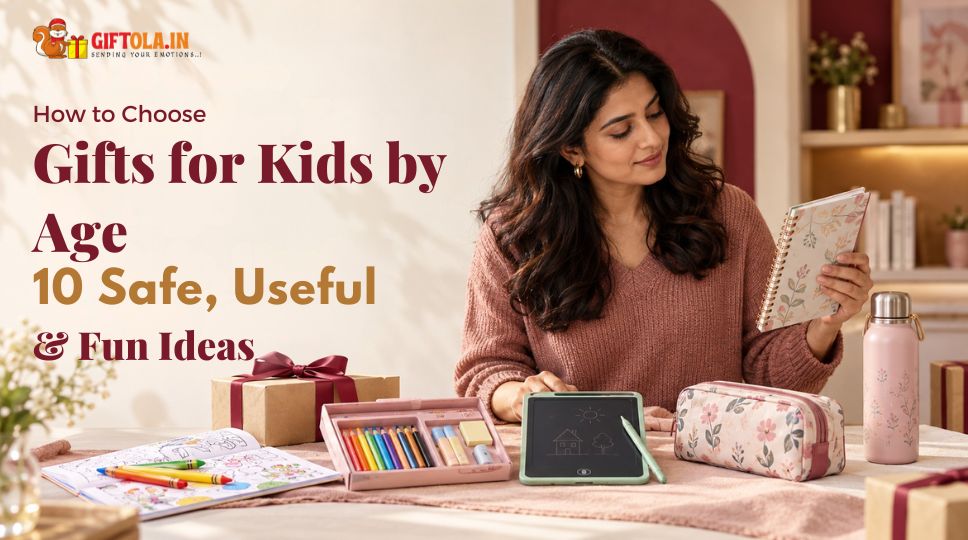
Choosing gifts for kids by age is one of the easiest ways to make gifting more thoughtful. A present that delights a three-year-old may feel too simple for an eight-year-old, while something designed for older children may be frustrating—or inappropriate—for a younger child. The goal is not to find the biggest, brightest or most expensive gift. It is to choose something that fits the child’s stage, interests, abilities and everyday life.
Giftola’s current catalogue includes several child-friendly directions such as stationery kits, writing and colouring products, keychains, coin boxes, activity items and return-gift options. Rather than treating every product as suitable for every age, this guide shows how to think about age fit first and then shortlist the right kind of gift.Browse the current Giftola shop
Why Age Matters When Choosing Gifts for Kids
Children change quickly. Their motor skills, attention span, reading ability, independence and interests can shift significantly in only a few years.
A younger child may enjoy sensory, matching or simple creative activities, while an older child may prefer more independent making, writing, collecting, organising or personal accessories.
Age is not the only factor. Interests, maturity and individual abilities matter too. Treat age guidance as a starting point rather than a substitute for knowing the child.
Safety matters especially when the gift is a toy or play product. The Bureau of Indian Standards (BIS) maintains Indian toy-safety standards, including requirements addressing mechanical and physical hazards, flammability and certain chemical risks. For toys sold in India, checking applicable BIS marking and age guidance is more useful than relying only on how attractive the packaging looks. Read BIS guidance on toy safety
A Quick Guide to Gifts for Kids by Age
| Age / stage | What often works | Useful gift directions | What to check |
| 2–4 years | Simple, hands-on, easy to understand | Large-format creative items, simple activity gifts, age-suitable play products | Small parts, sharp edges, age marking, supervision needs |
| 4–6 years | Creative play and early school-use items | Colouring, simple stationery, reusable drawing/writing activities | Complexity, mess level, choking risk, instructions |
| 6–9 years | Useful + fun gifts with more independence | Stationery kits, art supplies, organisers, coin boxes, simple accessories | Durability, practical use, age appropriateness |
| 9–12 years | More personal choice and hobby-led gifts | Notebooks, accessories, watches, creative kits, room/desk items | Style preference, usefulness, quality |
| 12+ years | Identity, utility and personal taste | Practical accessories, journals, tech-adjacent non-restricted items, personalised gifts | Taste, privacy, usefulness, quality |
10 Smart Ways to Choose the Right Gift
1. Start With the Child’s Stage, Not Just Their Birthday
A birthday number is helpful, but development and independence matter more. Ask what the child can comfortably use without constant adult help. For younger children, simplicity usually wins. For older children, gifts that give them more ownership—writing, organising, creating, collecting or choosing how to use the item—often feel more satisfying.
2. Choose Something They Can Actually Use
A gift does not become thoughtful simply because it looks cute. Useful gifts often stay in a child’s routine longer. Think about school, art time, travel, playtime, hobbies or their study desk. A stationery kit, reusable writing item, pouch or organiser can feel more valuable than an object that is exciting for ten minutes and then forgotten.
3. Match Complexity to Attention Span
A product can be safe and still be frustrating if it demands skills the child has not developed yet. For younger children, look for clear, short activities and immediate feedback. As children get older, longer projects, multi-step kits and tools that reward patience can become more appropriate.
4. For Toys, Check Safety Information Before Style
If the gift is a toy, activity toy or play product, look beyond colour and characters. Check age recommendations, warnings, small-part information and applicable certification. BIS toy-safety standards cover areas such as mechanical and physical hazards, flammability and migration of certain elements. The Department of Consumer Affairs also maintains consumer information on toys and safety regulations.
5. Use Creativity as a Filter
Creative gifts can work across several age groups when the difficulty is right. Colouring materials, drawing tools, stationery and activity items can turn a present into something the child actively does rather than simply owns. Giftola currently carries child-oriented creative and stationery products alongside return-gift options, so this can be a useful category to browse after deciding the age range.
6. Think About Repeat Use
Ask one practical question: can the child use this more than once? Repeat-use gifts—such as writing tools, pouches, organisers, art materials, bottles, diaries or desk items—can become part of everyday routines. That usually creates more long-term value than a novelty chosen only because it is trending.
7. For Group Gifting, Keep the Age Range Tight
Return gifts become harder when a party includes children from very different age groups. Instead of forcing one product to work for everyone, split the list into two age bands where possible—for example, preschoolers and school-age children. This makes it easier to choose gifts that are safer, more useful and more exciting for each group.
8. Personalise Carefully
Names, colours or a short message can make a child’s gift feel special, but personalisation should not make the product difficult to exchange or reuse. For group events, check every spelling before production. For older children, choose personalisation that feels age-appropriate rather than overly childish.
9. Avoid Buying Only by Price
Budget matters, especially for return gifts, but the lowest price should not be the only filter. Compare age fit, practical use, quality, presentation and safety. A simple, well-chosen item can feel more thoughtful than a larger bundle of random low-use products.
10. Let Interests Break the Tie
Once you have two or three age-appropriate options, use the child’s interests to decide. Do they draw? Write? Collect small things? Enjoy school supplies? Like practical accessories? Personal preference is what turns an age-suitable gift into a gift that feels genuinely chosen for them.
For parents and buyers in India who want an official consumer reference, the Department of Consumer Affairs page on Toys and Safety Regulations is a useful government source for understanding the regulatory context around toy safety.
Gift Directions by Age Group
Ages 2–4: Keep It Simple and Supervised
Choose large, easy-to-handle, age-marked products and simple creative activities. Avoid anything with small detachable parts unless the age guidance clearly supports it. At this stage, a gift should be intuitive enough that the child can understand what to do with minimal explanation.
Ages 4–6: Creativity Meets Early Independence
This is a useful stage for simple art, colouring and stationery-led gifts. Children are beginning to enjoy items that feel like “their own” school or creative supplies. Keep instructions short and make sure the product still suits their age and skill level.
Ages 6–9: Useful Gifts Become More Exciting
School-age children often appreciate gifts they can use independently—stationery kits, organisers, coin boxes, art supplies, writing tools or small accessories. Practical does not have to mean boring; colour, character and presentation can still make the gift feel celebratory.
Ages 9–12: Give Them More Choice
At this stage, personal taste becomes more important. Instead of choosing only by age, pay attention to colours, hobbies, school routines and what the child already owns. A journal, useful accessory, creative kit or desk item may feel more grown-up while still being fun.
Ages 12+: Move Toward Utility and Identity
Older children and teens often respond better to gifts that feel useful, personal or style-aware rather than overtly childish. Consider journals, practical everyday accessories, personalised items and products tied to their interests. When in doubt, simple and usable usually ages better than novelty.
A 60-Second Checklist Before You Buy
- Is the gift suitable for the child’s age and abilities?
- If it is a toy, does it carry appropriate safety and age information?
- Are there small parts, sharp edges, magnets, cords or other features that need attention?
- Can the child use the gift more than once?
- Does it match a real interest or routine?
- Is the quality appropriate for the way a child will use it?
- For return gifts, can it be distributed easily and consistently?
- For personalised gifts, are names and details checked before ordering?
Common Mistakes to Avoid
Choosing a gift only because it is trending: A viral product is not automatically right for a child’s age, interest or routine.
Ignoring age guidance on toys: Age labels and warnings are there for a reason. Treat them as part of the buying decision, not packaging clutter.
Buying the same return gift for toddlers and tweens: A wide age spread usually needs more than one gift direction.
Over-personalising: Too many names, photos or decorative details can make an otherwise useful gift less versatile.
Forgetting how the gift will be used: A good gift has a clear place in the child’s life: play, creativity, school, organisation, travel or memory-making.
Where Giftola Fits In
Giftola’s current shop includes a mix of birthday gifts, return gifts, stationery-led products, activity items, keychains, coin boxes, writing products and other affordable gifting options. The best way to use the catalogue is to start with age, safety and usefulness—then browse for the style, colour or presentation that makes the gift feel special.Explore Giftola’s current shop
If you are buying for a children’s party, Giftola also has existing editorial guidance on return gifts. Use that as an idea source, but still apply the age and safety filters in this guide before ordering for a group.Read Giftola’s kids’ return-gift article
Frequently Asked Questions
What are good gifts for kids by age?
Good gifts for kids by age are products that match the child’s developmental stage, interests and ability to use the item safely. Younger children usually benefit from simpler hands-on gifts, while older children often enjoy more independent, practical or hobby-led options.
How do I choose a safe toy gift in India?
Check the age recommendation, warnings, small-part information and applicable BIS marking/certification. For specific regulatory questions, refer to official BIS and Department of Consumer Affairs guidance.
What are useful gifts for school-age children?
Useful directions can include stationery, writing tools, art materials, pouches, organisers, coin boxes, bottles, journals and age-appropriate accessories.
Should return gifts be the same for every child?
They can be, if the children are in a similar age group and the product suits all of them. If the age range is wide, separating the gifts into two age bands can produce a better result.
Are personalised gifts suitable for children?
Yes, when the personalisation is age-appropriate and accurate. Names, colours or short messages can add meaning, but the core product should still be useful and appropriate.
Where can I browse gift ideas for kids online?
Giftola’s shop currently includes birthday and return-gift products, stationery-led items, creative products and practical everyday gifts. Availability can change, so review the live product page before ordering.
Final Thought: Age First, Gift Second
The simplest way to choose gifts for kids by age is to reverse the usual shopping process. Do not begin with the product. Begin with the child: their age, abilities, interests and routine. Then check safety where relevant, shortlist gifts they can genuinely use, and let colour, character and presentation add the fun. The result is a gift that feels exciting on the day—and still makes sense after the wrapping paper is gone.